


This Month in Queer Religious History*
May: Joan of Arc
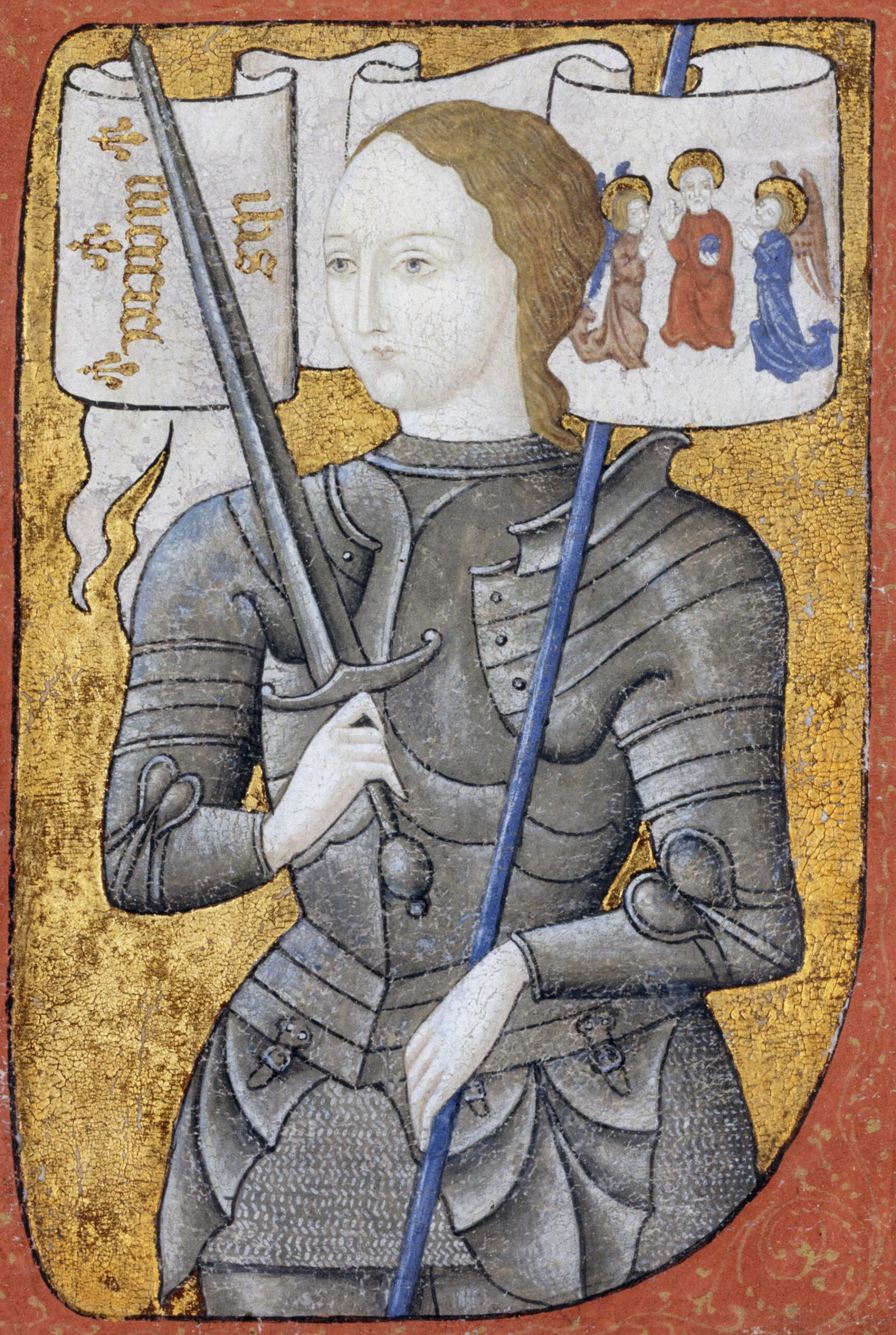
Joan of Arc
On 30 May 1431, a nineteen-year-old peasant girl from the village of Domrémy in France was burned at the stake in the marketplace of Rouen, condemned as a heretic by a court of church authorities acting in the interests of England during the final decades of the Hundred Years’ War. Her name was Jeanne d’Arc, Joan of Arc.
Five centuries later, on 16 May 1920, the same church that had condemned her canonized her as a saint.
Since her death, Joan of Arc has been claimed as a symbol of French nationalism, Catholic piety, feminist courage, and queer resistance. Few people from the medieval era have been the subject of more study. And no medieval saint has generated more urgent contemporary debate about gender identity, religious authority, and the price of living at the intersections of faith and resistance to political oppression.
A Life Guided by Saintly Voices
Born around 1412 to a farming family, Joan began, at thirteen years of age, to hear voices she identified as those of the Archangel Michael, Saint Catherine of Alexandria, and Saint Margaret of Antioch. These voices, she maintained, provided her with divine instruction: she was to travel to the court of the Dauphin Charles, help him reclaim his throne, and drive the English from France. This, of course, would have been an extraordinary claim for anyone to make, but it is more remarkable that this claim came from an illiterate teenage girl in a society that accorded women no authority in political or military matters.
It is astounding how seriously Joan was taken by those in power. After submitting to theological examination, Joan was granted an audience with Charles VII and subsequently given command of French troops. In 1429, she led the army to a decisive victory at Orléans, a turning point that helped consolidate Charles’s eventual coronation.
From the very beginning of her public life, Joan dressed in the clothing of a male knight: a short tunic, doublet, and hose, with her hair cut close above the ears, in a style her later accusers described as betraying her “true” identity as a woman.
Gender, Faith, and Their Trial
Joan’s cross-dressing was not incidental to her vocation; rather, as she testified, it was central to it. When pressed repeatedly by her judges to abandon male attire, she refused with words that have echoed across the centuries: “It pleases God that I wear it.”
She did not claim to be a man; Joan identified herself consistently as La Pucelle (“the Maiden”), and her virginity was a defining element of her self-understanding and her religious authority. Still, she clearly occupied a gendered space that medieval Christian leaders were unable to either comprehend or accept.
Scholars today approach Joan’s gender expression from a range of perspectives. Some historians believe that her cross-dressing was primarily strategic: that is, male dress offered practical protection and military authority that female dress could not. Others argue for reading Joan within a longer tradition of gender-nonconforming Christian figures, noting that the culture of fifteenth-century France already had fictional and legendary templates for assigned-female-at-birth warriors who lived and fought as men. Still others caution against anachronistically applying contemporary categories to a medieval person whose self-description does not map cleanly onto our present-day frameworks.
What is undisputed is that the charge of cross-dressing was central to Joan’s condemnation. The court’s transcript records its examiners’ outrage not merely at her wearing men’s clothes but at her cross-gendered expression as a whole: her short hair, her refusal of women’s dress even in prison, and above all her insistence that divine authority superseded ecclesiastical command.
When, after being shown instruments of torture and threatened with the stake, Joan appeared briefly to recant. She agreed to wear women’s clothing, but, within a few days, she resumed male dress. Her judges asked her why. She had done so, witnesses reported, because she could not bear to live otherwise, and because her voices had told her she had done wrong to return to wearing women’s clothing. For this, she was condemned to death.
The Complicated Legacy of Canonization
The theological and institutional reversal of Joan’s case is itself a remarkable chapter in the history of the church. Within two decades of her execution, Charles VII (who owed his throne to Joan) commissioned a re-examination of her trial. In 1456, a rehabilitation tribunal nullified the original condemnation, declaring the proceedings corrupt and politically motivated. Pope Callixtus III formally annulled the verdict.
The formal canonization came in 1920, under Pope Benedict XV, in a process that took centuries and that involved, at every turn, renegotiating the meaning of her gender expression rather than honestly reckoning with it. The church’s strategy in her rehabilitation was to reframe her cross-dressing as pragmatically necessary for protection against rape, an argument her own defenders had used at the rehabilitation trial, rather than to acknowledge the theological and spiritual weight she herself placed on it. Joan had said that her voices had commanded her to dress as she did. The institutional church preferred to say it was an unfortunate circumstance of war.
Why Joan Matters in Queer Religious History
Joan of Arc matters to queer religious history for several reasons.
First, she stands as a figure whose gender nonconformity was constitutive of her religious identity and life’s mission. She did not dress as she did despite her faith; she dressed as she did because of it. For people today whose gender expression is inseparable from their spiritual life, Joan’s witness offers a profound medieval antecedent and a powerful precedent.
Second, Joan’s story is, at least in part, about the limits of ecclesiastical. She was condemned by the institutional church but later vindicated by it. This trajectory should give pause to any community that confuses the church’s current disciplinary positions with supposedly unchangeable theological truth. Joan’s case is a reminder, embedded in Catholic hagiography itself, that the church has often been wrong about people it has persecuted (and still persecutes), and that time and the Spirit sometimes have a way of righting those records.
Third, Joan models an embodied, direct, and non-mediated encounter with the divine, one that the institutional gatekeepers of her day could not understand, control, or permanently suppress. Her mystical experiences were, by their very nature, uncontrollable by church authorities, and she paid for that with her life.
Finally, Joan’s contested afterlife is itself a lesson in the politics of religious symbolism. Today, Joan has been claimed by French nationalists and anti-immigrant movements that she would have found baffling, and yet she has also been claimed by LGBTQ+ communities as a patron saint of gender queer people because Joan’s defiant faith enabled her to embrace her call from an authority she understood to be divine.
Joan of Arc’s feast day is 20 May.
SOURCES
- Picture Source: “Derived from [Wikipedia] original commons upload at which is now in the history version: 01:39, 13. 8. 2005. Colour-graded to reveal more detail using GIMP software “curves” tool, Public Domain.” https://commons.wikimedia.org/w/index.php?curid=123841
- Bynum, Caroline Walker. Fragmentation and Redemption: Essays on Gender and the Human Body in Medieval Religion. New York: Zone Books, 1991.
- Bychowski, Gabrielle M.W. “The Patron Saint of Dysphoria: Joan of Arc as Transgender.” Transliterature: Things Transform, 28 May 2019. http://www.thingstransform.com/2019/05/the-patron-saint-of-dysphoria-joan-of.html.
- Bychowski, Gabrielle M.W. “Were There Transgender People in the Middle Ages?” The Public Medievalist, 1 November 2018. https://publicmedievalist.com/transgender-middle-ages/.
- Crane, Susan. “Clothing and Gender Definition: Joan of Arc.” Journal of Medieval and Early Modern Studies 26, no. 2 (1996): 297–320.
- Crane, Susan. The Performance of Self: Ritual, Clothing, and Identity During the Hundred Years War. Philadelphia: University of Pennsylvania Press, 2002.
- DeVries, Kelly. Joan of Arc: A Military Leader. Stroud: Sutton, 1999.
- Feinberg, Leslie. Transgender Warriors: Making History from Joan of Arc to Dennis Rodman. Boston: Beacon Press, 1996.
-
Pernoud, Régine, Marie-Véronique Clin, and Jeremy duQuesnay Adams. Joan of Arc : Her Story. Translated and Revised by Jeremy duQuesnay Adams . Edited by Bonnie Wheeler. New York: St. Martin’s Press, 1999.
- Wikipedia contributors. “Cross-dressing, Gender Identity, and Sexuality of Joan of Arc.” Wikipedia: The Free Encyclopedia. https://en.wikipedia.org/wiki/Cross-dressing,_gender_identity,_and_sexuality_of_Joan_of_Arc .
This Month in Queer Religious History
*Each month during 2025-2026, our 25th anniversary year, CLGS is honoring an individual, event, or movement of consequence in queer religious history. Although we will be able to highlight only a very few of those individuals and movements that have contributed to the thriving of LGBTQ+ persons and communities throughout history, we are eager to share with you the stories of some of the people and movements that have created positive change for LGBTQ+ people, our families, and our communities.