

This Month in Queer Religious History*
June: The 1972 Ithaca Statement on Bisexuality
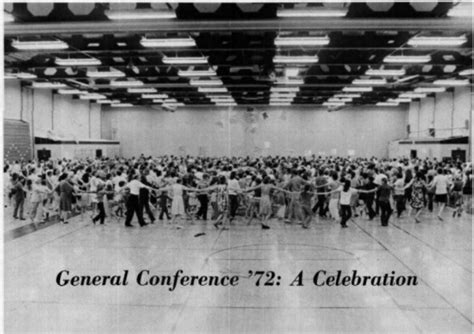
Friends General Conference 1972: Ithaca, New York
In late June of 1972, more than 100 Quakers (the popular name for members of The Society of Friends) gathered for an impromptu workshop at Ithaca College in Ithaca, New York, during the Friends General Conference, the annual gathering of socially-progressive Quakers in the US. The workshop was announced in the daily conference bulletin by Robert A. Martin Jr., a young bisexual activist who had earlier helped found the first gay student organization in the country at Columbia University.
The response was startling: so many people showed up for this workshop that they needed several adjoining rooms to include everyone. Over the course of two days, this self-convened group crafted and then adopted by consensus what would become known as the Ithaca Statement on Bisexuality.
Published that same year in Friends Journal: Quaker Thought and Life Today and in the LGBTQ+ magazine The Advocate, the Ithaca Statement is regarded by many scholars as the first public statement on bisexuality issued by a US religious group.
The Context: Quakers, Sexual Justice, and the Early 1970s
The early 1970s were an important period in queer religious history in the USA: only four years after the Stonewall Inn uprising in 1969, the American Psychiatric Association removed homosexuality from its official list of mental disorders (on 15 December 1973), and the “gay liberation movement” was gathering momentum and becoming a powerful agent of progressive social change in secular and in religious spaces.
The Society of Friends had long prided itself on its tradition of social witness by supporting abolition, women’s equality, pacifism, indigenous people’s rights, and prison reform, and Quakers have often taken the lead in calling for the human rights of marginalized groups.
The workshop that Martin convened in Ithaca met under the name the Committee of Friends on Bisexuality, and its members understood that many in the gay liberation movement, which was slowly becoming more visible within liberal religious circles, did not accept bisexual people into the movement. Bisexuality was dismissed by many as a transitional phase, as evidence of confusion, and/or even as a threat to emerging gay and lesbian identities and rights. The Ithaca Statement challenged all of these assumptions, and it did so in a particularly Quaker way.
The Statement
Quaker spiritual practice, unlike that of most Christian traditions, relies not on creeds or doctrinal pronouncements to shape its beliefs but draws upon “queries,” that is, open questions posed to the community for prayerful discernment. The Ithaca Statement adopted this form and crafted four queries for Friends everywhere to consider:
- Are Friends open to examining in our Meetings facets of sexuality, including bisexuality, with openness and loving understanding?
- Are Friends aware that Friends are suffering in our Meetings because they are not exclusively heterosexual? That Friends have felt oppressed and excluded, often without conscious intent; have felt inhibited from speaking Truth as they experience it? That Quaker institutions have threatened their employees with loss of jobs should their orientations become known?
- Are Friends, with their long tradition of concern for social justice, aware of the massive and inescapable bigotry in this area directed and perpetuated by virtually all United States institutions, to wit: all branches of government; churches; schools; employers; landlords; medical, bar, and other professional associations; insurance companies; news media; and countless others?
- Are Friends aware of their own tendency to falsely assume that any interest in the same sex necessarily indicates an exclusively homosexual orientation; and to further falsely assume that interest in the opposite sex necessarily indicates an exclusively heterosexual orientation?
These four queries called for an end to religious intolerance, societal bigotry, and institutional oppression. They also speak candidly about the suffering of Quakers who “are not exclusively heterosexual” and of those afraid to speak their truth. Significantly, the fourth query criticizes Quakers who think of sexual “orientation” as a binary, that is, as characterized by two mutually-exclusive categories.
Robert A. Martin Jr. (1946-1996) and the Bisexual Movement
The person most responsible for convening the Ithaca workshop, Robert A. Martin Jr., was born in 1946 in Norfolk, Virginia. Coming out as gay while a student at Columbia University in the late 1960s, Martin helped found the Student Homophile League, the first gay student organization in the country. After graduation, he served in the US Navy, explored Buddhism, and deepened his engagement with the Society of Friends. Over time, he came to understand himself as bisexual and to see the invisibility of bisexual people within both straight and gay communities as a specific injustice requiring education and advocacy.
Martin wrote about (and for) the bisexual movement using several pseudonyms, including Stephen Donaldson (under which he had done his earlier gay rights organizing) and Donny the Punk, a name that reflected his deep involvement in punk culture and his advocacy on behalf of survivors of prison rape, a cause to which he devoted much of the later years of his life after his own assault during a 1973 incarceration following an anti-war protest.
Martin understood the Ithaca gathering as an important historic moment. In his report published in The Advocate, he described what was happening in that overflow room at Ithaca College as, in his own judgment, possibly the first organized effort by bisexual people to organize themselves in American history.
Why the Ithaca Statement Matters in Queer Religious History
The Ithaca Statement matters for several reasons:
First, it shows that a religious community can be at the forefront of LGBTQ+ advocacy. The Ithaca Statement predates the mainstream acceptance of bisexuality within most religious traditions and within society at large. It is significant that a group of Quakers, gathering in a college gymnasium in upstate New York, raised questions that their denomination as a whole, and that many other people of faith throughout the USA, would not wrestle with for decades to come.
Second, the Statement names what we now term “biphobia” with a directness that religious communities have often been slow to acknowledge. Bisexual people are not simply gay or lesbian people who have not yet come all the way out; rather, they are people whose full humanity is routinely denied by a culture that insists on viewing the sexual richness and complexity of human identities in either/or categories.
Third, the Ithaca Statement provides an excellent example of how a tradition’s own spiritual practices can be directed toward justice. The Quaker query is not an instrument of coercion; rather, it is an invitation to look carefully and honestly at reality, including a reality that many are unable to see clearly. Martin and his collaborators used that instrument to invite an entire tradition to see what was right in front of it: that people were suffering, that the suffering was unnecessary, and that the community had both the capacity and the responsibility to respond with justice and in a spirit of love.
Finally, as communities of faith today mark Pride Month this June, the Ithaca Statement is a reminder that bisexual people, their lives, and their distinctive experiences of marginalization within both religious and secular LGBTQ+ spaces deserve explicit recognition, and not mere “inclusion” by implication.
The “B” in LGBTQ+ has too often been rendered invisible even in communities that claim to welcome the whole. The Quakers who gathered in this committee at Ithaca College in the summer of 1972 knew this, and they strove to advocate for the right of bisexual people everywhere to live and love freely and without fear.
The Friends General Conference 1972 was convened from 24 June through 1 July. The Ithaca Statement was adopted by the workshop group during that week.
SOURCES
- Picture Source: https://discover.stqry.app/1/tour/52784/19803/item/337544
- Committee of Friends on Bisexuality. “Ithaca Statement on Bisexuality.” Friends Journal: Quaker Thought and Life Today, August 1/15, 1972.
- Denkinson, Grant. “The Ithaca Statement.” The Friend, 13 July 2012. https://thefriend.org/article/the-ithaca-statement
- Hutchins, Loraine, and Lani Kaahumanu, eds. Bi Any Other Name: Bisexual People Speak Out. Boston: Alyson Publications, 1991.
- LGBTQ Religious Archives Network. “Stephen Donaldson.” https://lgbtqreligiousarchives.org/profiles/stephen-donaldson
- Martin, Robert A. (Stephen Donaldson). Report on the Ithaca Workshop on Bisexuality. The Advocate, August 1972, p. 8.
- Yoshino, Kenji. “The Epistemic Contract of Bisexual Erasure.” Stanford Law Review 52, no. 2 (2000): 353–461.
This Month in Queer Religious History
*Each month during 2025-2026, our 25th anniversary year, CLGS is honoring an individual, event, or movement of consequence in queer religious history. Although we will be able to highlight only a very few of those individuals and movements that have contributed to the thriving of LGBTQ+ persons and communities throughout history, we are eager to share with you the stories of some of the people and movements that have created positive change for LGBTQ+ people, our families, and our communities.