


This Month in Queer Religious History*
July: Marsha P. Johnson
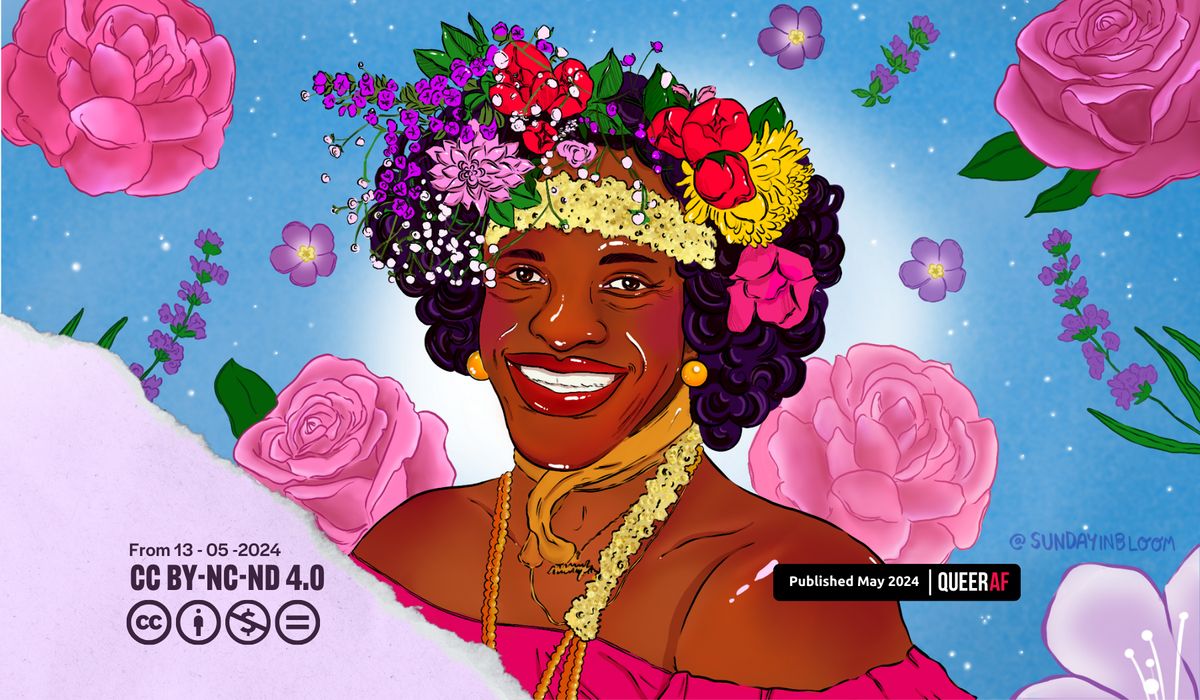
Marsha P. Johnson
On 6 July 1992, the body of Marsha P. Johnson, only 46 years old, was recovered from the Hudson River in New York City, not far from the Christopher Street pier where she had spent so much of her life.
A central figure in the Stonewall uprising of 1969 and co-founder of Street Transvestite Action Revolutionaries (STAR), Johnson was a fierce advocate for homeless queer young people as well as those struggling to survive the AIDS epidemic. What many do not know today, however, is that she was also a woman of faith with a vibrant spirituality.
From the Mount Teman AME Church to Christopher Street
Born Malcolm Michaels Jr. on 24 August 1945 in Elizabeth, New Jersey, Marsha was one of seven children of an assembly-line worker and a housekeeper. As a child, she belonged to the Mount Teman African Methodist Episcopal Church, and her family regularly attended Sunday services there.
As she grew into adulthood, Marsha continued to ground herself in a deep spirituality that was a hallmark of her activism and advocacy for her Trans siblings facing ostracization from many within the lesbian and gay movement and from the outside world.
As many know, the “P.” in the name that Marsha chose for herself stood for “Pay It No Mind,” a phrase that she offered to anyone who pressed her about her gender. She often called herself a drag queen, a transvestite, or simply a queen: these were terms common at the time. Marsha used the pronouns “she” and “her” for herself.
The word “transgender” was not yet in wide use in her day, but today she is most often remembered as a Black transgender woman who is one of the most significant figures of the contemporary movement for transgender and queer liberation.
A Life of Devotion
As the historian Ahmad Greene-Hayes has shown, Johnson crafted a personal spirituality that drew upon the Black Protestant Christianity of her youth, a lifelong attraction to Catholicism, and the Afro-Cuban tradition of Santería. She created a personal faith and life-giving spirituality that extended well beyond the limitations of any single tradition.
Marsha was at home praying in churches of many Christian denominations, and she often prayed at a synagogue, explaining with characteristic wit that she was “covering all angles.” One friend remembered finding her in a church, dressed in velvet and throwing glitter into the air while praying with her back to the altar, because she believed one shouldn’t look directly at something as sacred as an altar. Sylvia Rivera, her closest friend and co-founder of STAR, recalled that after the death of Johnson’s partner, Marsha arrived at her door dressed as the Virgin Mary and ready to preach, robed in white and blue, with a Bible in one hand and a wooden cross in the other.
“He Takes Me Seriously”
Marsha spoke of herself as married to Jesus. To those who dismissed her, in the cruel and ableist language so often used against poor Black trans women, she answered simply that Jesus took her seriously. Living in a world in which she encountered arrest, poverty, and ridicule, she found dignity and fulfillment in being known and valued by God.
Joy Ellison and Nicholas Hoffman, in reading Marsha’s life through the lens of medieval sanctity, invite us to see her as deeply connected to a theology of suffering and a call to holy foolishness. Marsha was a visionary whose life was a gift to countless others, in spite of (and perhaps because of) the suffering that she experienced. And yet, like many other saints throughout history, she was a truth-teller who embraced a vocation to spread joy and love to those she encountered day after day.
Faith Made Visible: STAR and the Care of the Abandoned
Marsha’s faith was never confined to churches or synagogues. Rather, she expressed her beliefs in the work she embraced on behalf of others. STAR, which she founded with Rivera in 1970, provided shelter, food, and clothing for young homeless people who had nowhere else to go.
In her last years, living with HIV, Johnson marched with ACT UP and prayed over suffering and dying from the epidemic. Greene-Hayes describes Johnson and Rivera as street evangelists and political organizers; for Johnson, her work among and for the abandoned was inspired and sustained by her own deep relationship with Jesus.
Why Marsha P. Johnson Matters in Queer Religious History
In remarkable ways, Johnson reminds us that faith and spirituality are most alive where it is least expected. She held no degrees in theology, led no congregation, and wrote no books on ministry, and yet, few people in history have prayed more fervently, been alive to the presence of the Divine more keenly, or extended the love of God more concretely to the despised than she did. Hers was a life that wove together the spiritual and the political. This same woman who lay prostrate before a statue of the Virgin Mary at dawn often spent her days tirelessly defending sex workers, protecting runaways, and nursing the sick and dying. Johnson lived out her religious calling by caring for others.
Sadly, the circumstances of her death have never been resolved. Although police ruled her death a suicide, her friends fought successfully to have her case reopened. And still, no definitive conclusions have been reached regarding the cause of her death.
Today, this “Saint of Christopher Street” has become an icon of queer religious history because she was a Black trans woman whose ministry of care for others was deeply rooted in her fierce and tender faith. Marsha P. Johnson was a woman in love with the Divine and in love with people. In this month of July, we do pay her mind and celebrate her life and witness.
SOURCES
- Picture Source: https://www.linkedin.com/posts/queeraf_marsha-p-johnson-image-free-to-use-for-activity-7198639082774642688-W_gu
- African American Registry. “Marsha P. Johnson, LGBT Pioneer Born.” Accessed June 20, 2026. https://aaregistry.org/story/marsha-p-johnson-lgbt-pioneer-born/.
- Chan, Sewall. “Marsha P. Johnson: A Transgender Pioneer and Activist Whose Death Was Never Fully Investigated.” The New York Times, “Overlooked” Obituary Series, March 8, 2018. https://www.nytimes.com/interactive/2018/obituaries/overlooked-marsha-p-johnson.html
- Ellison, Joy and Nicholas Hoffman. “The Afterward: Sylvia Rivera and Marsha P. Johnson in the Medieval Imaginary.” Medieval Feminist Forum: A Journal of Gender and Sexuality 55, No. 1 (2019): 267-294.
- France, David, dir. The Death and Life of Marsha P. Johnson. Public Square Films and Netflix, 2017. 105 min.
- Greene-Hayes, Ahmad. “Street Evangelists and Transgender Saints: Sylvia Rivera, Marsha P. Johnson, and the Religions of the Afro-Americas.” QTR: A Journal of Trans and Queer Studies in Religion 1, no. 1 (2024): 32–52. https://doi.org/10.1215/29944724-11208911.
- Kasino, Michael, dir. Pay It No Mind: The Life and Times of Marsha P. Johnson. Frameline, 2012. 55 min.
- The Marsha P. Johnson Institute. Official Resource Center. Accessed June 20, 2026. https://marshap.org/.
- National Women’s History Museum. “Marsha P. Johnson.” 2022. https://www.womenshistory.org/education-resources/biographies/marsha-p-johnson
- Outreach. “Remembering Transgender Icon Marsha P. Johnson, a Saint of Welcome.” August 9, 2022. https://outreach.faith/2022/08/remembering-transgender-icon-marsha-p-johnson-a-saint-of-welcome/.
- Tourmaline. Marsha: The Joy and Defiance of Marsha P. Johnson. New York: Tiny Reparations Books, 2025.
This Month in Queer Religious History
*Each month during 2025-2026, our 25th anniversary year, CLGS is honoring an individual, event, or movement of consequence in queer religious history. Although we will be able to highlight only a very few of those individuals and movements that have contributed to the thriving of LGBTQ+ persons and communities throughout history, we are eager to share with you the stories of some of the people and movements that have created positive change for LGBTQ+ people, our families, and our communities.