

This Month in Queer Religious History*
The 1993 March on Washington for Lesbian, Gay, and Bi Equal Rights
On 25 April 1993, the March on Washington for Lesbian, Gay, and Bisexual Equal Rights and Liberation brought together approximately one million people for one of the largest civil rights demonstrations in US history. Organized at a time when queer people were responding to an onslaught of anti-LGB realities in US society (including the reality of hate crimes, the US military’s impending “Don’t Ask, Don’t Tell” policy, Colorado’s Amendment 2, and the ongoing devastation of the AIDS crisis), the March assembled a powerful coalition of queer individuals and organizations on the capital’s National Mall to protest and to call for equal rights.
It is important to note that LGBTQ+ people of faith and their allies (from a variety of religious and spiritual traditions) were both leaders and participants in the March, continuing a long tradition of US social justice protest that has brought together the sacred and the political.
In the days before and after 25 April, Washington became host to a remarkable offering of political workshops, candlelight vigils, historical exhibits, and religious services and ceremonies. These events mark a neglected but vital chapter in our nation’s history of queer religious activism, and it is especially important to recall and honor this event in April 2026, when the lives, loves, and liberties of LGBTQ+ people and our families are under threat from political leaders at the local, state, and national levels.
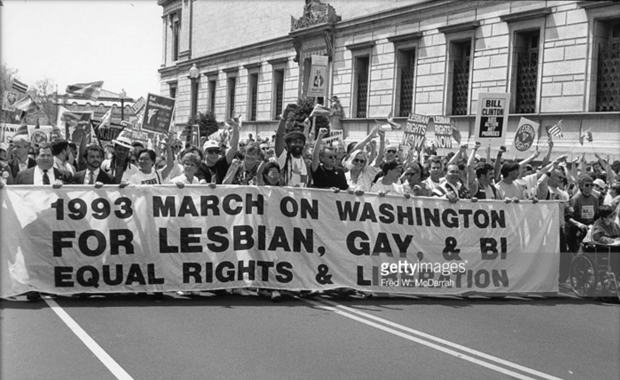
Demonstrators Marching with Banner: March on Washington for Gay, Lesbian, and Bi Equal Rights and Liberation, 25 April 1993. SOURCE: Getty Images.
A March That Named Religion
The march’s official platform explicitly linked LGB liberation to the struggle against religious intolerance, demanding “an end to discrimination and violent oppression based on actual or perceived sexual orientation, identification, race, religion, identity, sex and gender expression, disability, age, class, AIDS/HIV infection.” Far from being incidental to the March’s agenda, religion was named explicitly as among one source of oppression that the movement pledged to confront. At the same time, many marchers came as people of faith who refused to surrender their religious identities or spiritual lives, even if some religious institutions had rejected them.
The Big Gay Wedding: A Prayer Demonstration for Marriage Equality
Among the most striking religious acts of the march weekend was “The Wedding,” a mass blessing of approximately 2,000 same-sex couples assembled at the National Museum of Natural History on 24 April, the day before the march. The Washington Post described the scene: “a dozen ministers, organ music, photographers and rice”, in a celebration that also was both political and theological in its significance. Because same-sex marriage was not yet legally recognized anywhere in the country, the ceremony was not legally binding, but those who married understood their weddings as something much more than merely symbolic.
The event was organized in significant part by the Universal Fellowship of Metropolitan Community Churches (MCC), the denomination founded in 1968 by Rev. Troy Perry as a Christian community for LGBTQ+ people and their allies. Rev. Kittredge Cherry, then serving as MCC’s ecumenical and public relations officer, handled media relations for The Wedding, describing it as a prayer demonstration for equal marriage rights.
A Vigil at the Holocaust Museum
The week of the March coincided with the opening of the United States Holocaust Memorial Museum. Gay and lesbian children of Jewish Holocaust survivors had worked for years to ensure that queer victims of Nazi persecution were part of the museum’s memorialization. During the week, a candlelight vigil was held at the Museum for gay victims of the Holocaust. As Barrett Brick, Executive Director of the World Congress of Gay and Lesbian Jewish Organizations, remarked, “Never again will the world deny we were killed for whom we loved.”
Faith Motivating Activism
LGBTQ+ people of faith marched on Washington in 1993, not in spite of their faith but because of it. They came bearing the conviction that their traditions had something true and necessary to say about human worth, about the sacred character of intimate love, and about the moral urgency of justice. The Rev. Jesse Jackson, speaking at the Capitol rally, called for “No more homophobia. Let’s respect people, protect people. Everyone is somebody.”
For CLGS, this history is living history because the marchers who showed up in Washington DC in late April of 1993 were doing theology in public. In addition, their activism marks an important chapter in our Queer Religious History. Let us honor and celebrate them!
SOURCES
- “25 Photos from the March on Washington for Lesbian, Gay, and Bi Equal Rights and Liberation of 1993.” History Collection, n.d. https://historycollection.com/25-photos-march-washington-lesbian-gay-bi-equal-rights-liberation-1993/ . Accessed 27 March 2026.
- Cherry, Kittredge. “Historic MCC Photos from Kittredge Cherry.” QSpirit, 8 October 2023. https://qspirit.net/metropolitan-community-churches/. Accessed 27 March 2026.
- Chibbaro Jr., Lou. “Our History of Marching on Washington.” Washington Blade, 11 June 2017. https://www.washingtonblade.com/2017/06/11/history-marching-washington/. Accessed 27 March 2026.
- com. “Marches on Washington.” https://www.encyclopedia.com/social-sciences/encyclopedias-almanacs-transcripts-and-maps/marches-washington. Accessed 27 March 2026.
- Kane, Christopher, and Karen Ocamb. “The 1993 March on Washington Remembered: A Paradigm Shifting Event in LGBTQ history.” Los Angeles Blade, 23 September 2018. https://www.losangelesblade.com/2018/09/23/the-1993-march-on-washington-remembered-photo-essay/. Accessed 30 March 2026.
- Leavitt, Sarah. “Top Ten Most Important LGBTQ Marches in DC.” Capital Jewish Museum, 12 June 2025. https://capitaljewishmuseum.org/top-ten-most-important-lgbtq-marches-in-dc/ . Accessed 30 March 2026.
- Milward, Candace. “Mass Wedding Marries Tradition and Protest.” Washington Post, 25 April 1993. https://www.washingtonpost.com/archive/politics/1993/04/25/mass-wedding-marries-tradition-and-protest/3b9b2fd5-4f5f-40e9-95c6-9302232fd802/. Accessed 27 March 2026.
- National LGBTQ Task Force. “Reflections on the 1993 March on Washington.” https://www.thetaskforce.org/news/reflections-on-the-1993-march-on-washington/. Accessed 27 March 2026.
- “Platform of the 1993 March on Washington for Lesbian, Gay, and Bi Equal Rights and Liberation Action Statement.” http://www.qrd.org/qrd/events/mow/mow-full.platform. Accessed 27 March 2026.
- Ring, Trudy. “Remembering Jesse Jackson’s Longtime Advocacy for LGBTQ+ Equality.” The Advocate, 18 February 2026. https://www.advocate.com/politics/national/jesse-jackson-lgbtq-rights-record . Accessed 27 March 2026.
- Sanchez, Rene, and Linda Wheeler. “On the March, in Joy and Pain: Gay Activists Begin Gathering amid Celebrations and Protests.” Washington Post, 23 April 1993. https://www.washingtonpost.com/archive/politics/1993/04/24/on-the-march-in-joy-and-pain/a79fd1e8-d0bd-4d45-9556-c64fde610071/ . Accessed 30 March 2026.
- “March on Washington for Lesbian, Gay and Bi Equal Rights and Liberation.” Click here. Last modified 14 February 2025. Accessed 27 March 2026.
This Month in Queer Religious History
*Each month during 2025-2026, our 25th anniversary year, CLGS is honoring an individual, event, or movement of consequence in queer religious history. Although we will be able to highlight only a very few of those individuals and movements that have contributed to the thriving of LGBTQ+ persons and communities throughout history, we are eager to share with you the stories of some of the people and movements that have created positive change for LGBTQ+ people, our families, and our communities.