

1 January 2026
This Month in Queer Religious History*
The 1965 New Year’s Benefit Ball in San Francisco
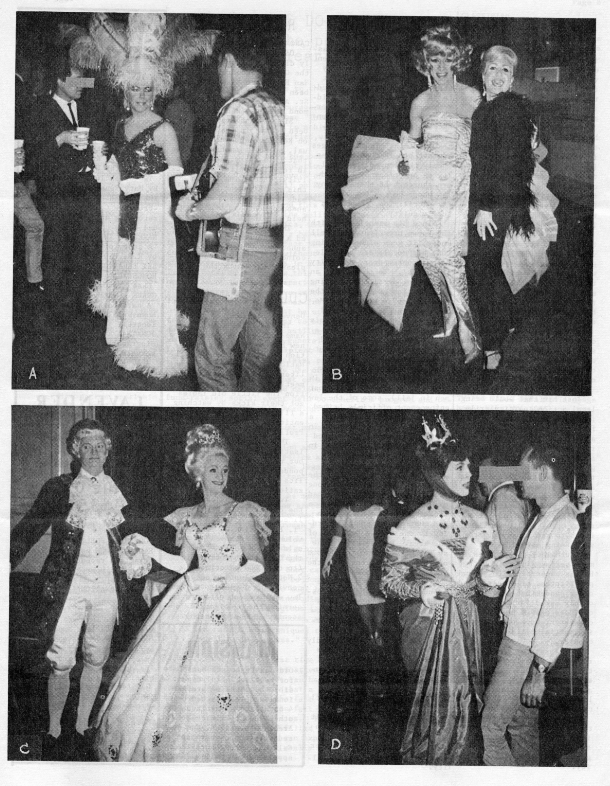
“Drag queens and attendees at the New Year’s Mardi Gras Ball, held at California Hall in San Francisco on January 1, 1965. Photos from the Citizen’s News, in the Periodicals Collection of the GLBT Historical Society.” [San Francisco Bay Times: 31 Dec 2025]
On 1 January 1965, the New Year’s Benefit Ball was held in San Francisco, a landmark event that brought together queer communities, drag performers, and religious leaders in a celebration of solidarity and resistance. This gathering, organized to raise funds for queer and trans individuals facing homelessness and discrimination, became a powerful symbol of the intersection between spirituality, activism, and queer liberation.
For the queer community and its allies, the Benefit Ball was more than a party: it was a sacred act of defiance and care, embodying the spiritual imperative to uplift the marginalized and challenge societal oppression.
The mid-1960s were a time of intense persecution for gay, lesbian, and trans people, particularly drag queens and transgender women, who faced frequent police harassment, violence, and exclusion from mainstream society. In this climate, the New Year’s Benefit Ball emerged as a rare space of joy and sanctuary. Organized by community leaders like José Sarria, a drag performer and activist, the event also drew the support of progressive religious figures who recognized the moral urgency of standing with the queer community. These leaders saw their participation not as a contradiction but as an extension of their faith’s call to love and justice.
Religious communities played a pivotal role in the Benefit Ball. While many institutions at the time condemned queer identities, a handful of courageous clergy and congregations stepped forward to offer spiritual and material support. Glide Memorial Methodist Church, led by Rev. Cecil Williams, was among the first to align itself with the queer liberation movement. Glide’s commitment to radical inclusivity and social justice made it a natural ally for events like the Benefit Ball, where religious leaders mingled with drag performers to raise funds for those in need.
Similarly, the Council on Religion and the Homosexual (CRH), founded in 1964, played a key role in bridging faith and queer activism. Comprised of progressive ministers and queer advocates, the CRH challenged the moral hypocrisy of churches that excluded queer people while claiming to preach love. Their presence at the Benefit Ball (through fundraising, advocacy, or simply showing up) signaled a growing recognition among at least some faith leaders that standing up for gay and lesbian people was a theological imperative.
The spiritual dimensions of the Benefit Ball were significant. For many attendees, the event was a ritual of survival and affirmation, a space where the sacred and the profane intertwined. Drag performances, often dismissed as frivolous or even morally degenerate by many outsiders, took on a transcendent quality, embodying the resilience and creativity of a community under siege. The Ball’s very existence was an act of faith and signaled a belief that a more just world was possible, even in the face of overwhelming oppression.
The Benefit Ball also challenged religious communities to confront their complicity in systemic injustice. By participating, faith leaders like Rev. Williams and members of the CRH demonstrated that religion could be a force for liberation rather than repression. Their actions echoed the teachings of many traditions: Jesus’ solidarity with the outcast, the Jewish concept of tzedakah (righteous giving), and the universal call to “love one’s neighbor.”
The Ball was not just a fundraiser; it was a living testimony to the power of faith in action.
The legacy of the 1965 New Year’s Benefit Ball endures today. It reminds us that the fight for LGBTQ+ rights has always been intertwined with the struggle for spiritual and material justice. The event also paved the way for future collaborations between queer activists and faith leaders, from the AIDS crisis of the 1980s to the ongoing movements for trans rights and racial equity.
As we honor this history in January 2026, we celebrate the religious leaders who dared to stand with queer communities, and we challenge contemporary faith communities to continue this legacy of radical love especially in an era of renewed political oppression throughout the United States today.
The Benefit Ball teaches us that solidarity is sacred, and that the work of justice is never done.
As we enter a new year, let us celebrate, honor, and embody this spirit of courage, compassion, and unapologetic joy.
SOURCES
- Boyd, Nan Alamilla. Wide Open Town: A History of Queer San Francisco to 1965. University of California Press, 2003.
- GLBT Historical Society. ”José Sarria and the Imperial Court System.” Accessed 31 December 2025: https://www.glbthistory.org/jose-sarria.
- Glide Memorial Church. ”Our History: Rev. Cecil Williams and LGBTQ+ Advocacy.” https://www.glide.org/history. Accessed [current date].
- Meeker, Martin. Contacts Desired: Gay and Lesbian Communications and Community, 1940s–1970s. University of Chicago Press, 2006.
- San Francisco Chronicle Archives. ”1965 New Year’s Benefit Ball Coverage.” (January 2, 1965 edition).
- Shaffer, Andrew. “A New Year and an Old Story.” San Francisco Bay Times (31 Dec 2025). Accessed 31 December 2025: https://sfbaytimes.com/a-new-year-and-an-old-story/
- Stryker, Susan. Transgender History: The Roots of Today’s Revolution. Seal Press, 2008.
This Month in Queer Religious History
*Each month during 2025-2026, our 25th anniversary year, CLGS is honoring an individual, event, or movement of consequence in queer religious history. Although we will be able to highlight only a very few of those individuals and movements that have contributed to the thriving of LGBTQ+ persons and communities throughout history, we are eager to share with you the stories of some of the people and movements that have created positive change for LGBTQ+ people, our families, and our communities.